

Builder selection is defined as the formal process by which a property manager evaluates, vets, and appoints a construction firm based on quality, financial stability, legal compliance, and communication. Getting this process right determines whether a project finishes on time, on budget, and to a standard that protects your investment. The criteria for choosing a builder go well beyond price. A balanced selection matrix weights Quality at 40%, Financial Stability at 25%, Communication at 15%, Price at 15%, and Personal Fit at 5%. Understanding how a property manager selects a builder through this lens, rather than defaulting to the cheapest quote, is the single most reliable way to avoid costly disputes and project failures.
What key criteria should a property manager use to select a builder?
The cheapest bid is rarely the best bid. A builder who underquotes to win work often recovers margin through variations, delays, or inferior materials. Weighting your criteria correctly from the outset protects you from this pattern.

The quality-first selection approach places quality of workmanship at the top of the matrix for good reason. Poor quality triggers remedial costs, tenant complaints, and potential liability. Financial stability matters almost as much. A builder with cash flow problems will slow your project, delay material orders, and may abandon the site entirely.
Insurance verification is non-negotiable. Builders must carry a minimum of £2 million in public liability insurance, with £5 million recommended for larger or more complex projects. Always request the certificate directly and verify it against the insurer, not just the builder’s word.
| Criterion | Weighting | What to check |
|---|---|---|
| Quality of workmanship | 40% | Portfolio, site visits, references |
| Financial stability | 25% | Credit checks, trade references, payment history |
| Communication | 15% | Response times, written updates, site meetings |
| Price | 15% | Itemised quotes, not lump sums |
| Personal fit | 5% | Shared understanding of project goals |
Experience and specialisation also matter. A builder skilled in residential extensions may lack the competencies needed for a commercial fit-out. Always match the builder’s track record to your specific project type, whether that is loft conversions, structural brickwork, or full renovation programmes.
Pro Tip: Ask every builder to provide an itemised quote rather than a single lump sum. Itemised quotes reveal where costs are concentrated and make it far easier to compare like for like across multiple tenders.
How do you practically vet and shortlist builders?
Shortlisting requires active research, not passive enquiry. Trade associations, local recommendations from other property managers, and direct site visits all produce better intelligence than online directories alone.
Local material suppliers are an underused intelligence source. Staff at builders’ merchants often know which contractors pay their accounts reliably and run professional operations. A builder who is slow to pay suppliers is likely to be slow on site too.
For occupied residential properties, request references from at least three apartment complex managers or landlords, focusing specifically on punctuality, noise management, and site cleanliness within tenant units. These details matter far more than a glossy portfolio when tenants are living on site.
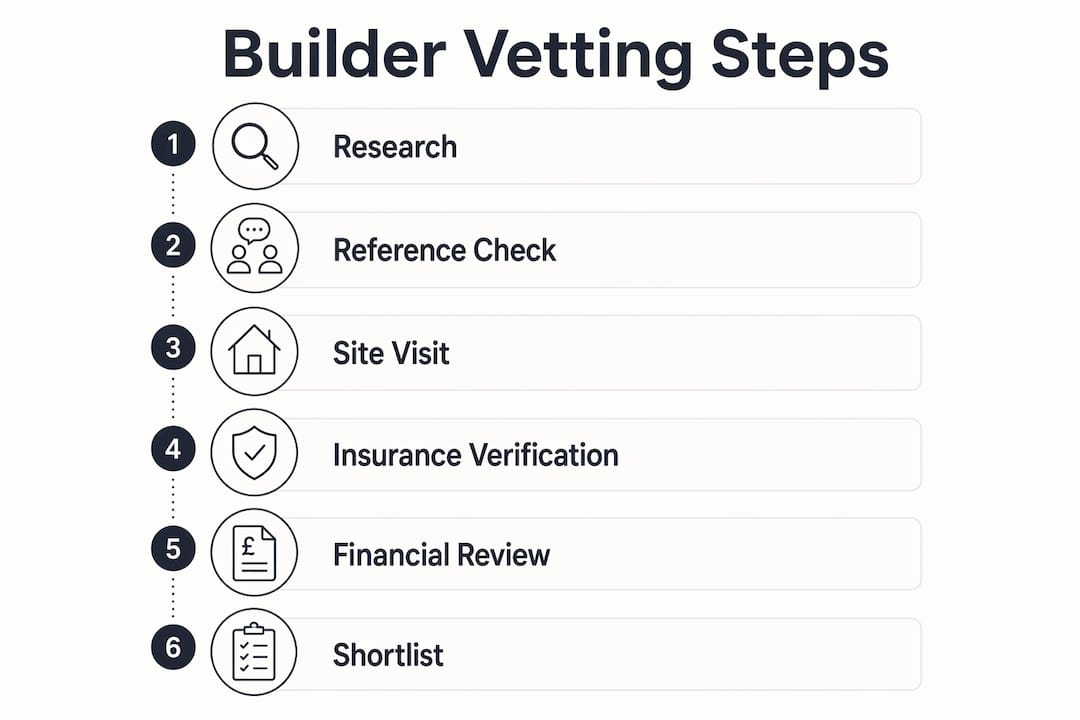
A practical vetting process covers these steps:
- Build an initial longlist from trade association registers, Federation of Master Builders membership, and personal referrals from trusted peers.
- Verify public liability insurance certificates directly with the insurer.
- Check the builder’s registration on Companies House for financial health and trading history.
- Visit at least one current or recently completed project to assess site organisation and finish quality.
- Conduct structured reference calls with previous clients, asking specific questions about budget adherence and communication.
- Confirm the builder’s experience with your specific project type before inviting a formal tender.
- Narrow to three firms for competitive tender, ensuring all quote against an identical scope document.
Pro Tip: When visiting a current project, pay attention to how the site is organised. Tidy, well-labelled materials and clear safety signage indicate a builder who manages process well, not just output.
What contract and payment terms should property managers enforce?
A well-structured contract is the single most effective tool for protecting a property manager’s interests. Without clear terms, disputes over scope, cost, and timeline become almost inevitable.
Milestone-based payment schedules are the standard best practice. Payments must relate to verified work stages, not calendar dates. This aligns the builder’s financial incentive with delivery, reducing the risk of overpayment or site abandonment. Upfront deposits should not exceed 20% of the total contract value, with 10–15% being the typical and more cautious range.
The JCT Home Owner Contract is the recognised standard template for residential projects in England and Wales. It covers scope, timelines, payment schedules, and dispute resolution in plain language. Using a recognised contract template removes ambiguity and gives both parties a clear reference point if disagreements arise.
Change orders are the most common source of post-contract disputes. Contracts must explicitly define the process for requesting, pricing, and approving any variation to the original scope. Without this, builders can add costs informally and property managers have limited recourse.
A numbered checklist of contract essentials:
- Defined project scope with detailed specifications attached
- Milestone-based payment schedule tied to verified completion stages
- Maximum upfront deposit of 20%, ideally 10–15%
- Written change order process with mandatory sign-off before work proceeds
- Clear timeline with agreed completion date and delay penalties
- Defects liability period of at least 12 months post-completion
- Dispute resolution clause referencing an independent adjudicator
“The contract is not a formality. It is the document that defines what you are buying, when you will receive it, and what happens if you do not. Property managers who treat it as a box-ticking exercise are the ones who end up in costly disputes.”
Why do long-term builder partnerships reduce overhead for property managers?
A trusted builder who understands your portfolio is worth considerably more than a new contractor who quotes slightly lower. The time cost of vetting, briefing, and managing an unfamiliar builder on every project adds up quickly.
39% of property managers report spending excessive time managing maintenance requests. Pre-vetted builder rosters directly reduce this burden. When you already trust a builder’s quality and reliability, you spend less time supervising and more time managing your portfolio strategically.
Directing 80% of maintenance work to two trusted contractors, rather than spreading work across many, reduces coordination overhead and builds genuine site familiarity. A builder who has worked across several of your properties understands your standards, your tenants’ expectations, and your financial goals without needing to be briefed from scratch each time.
The benefits of a consolidated builder roster include:
- Faster mobilisation on urgent repairs, because the relationship and paperwork already exist.
- Consistent finish quality across your portfolio, reducing remedial work.
- Better pricing over time, as the builder values the ongoing relationship.
- Reduced administrative time spent on tendering, vetting, and onboarding.
- A builder who proactively flags potential issues during routine visits, acting as an extension of your management function.
Understanding renovation project stages in advance also helps property managers brief trusted builders more efficiently, reducing the back-and-forth that slows projects down.
Key takeaways
Selecting a builder on quality, financial stability, and contract rigour, rather than price alone, is the most reliable way to protect a property management portfolio from costly delays and disputes.
| Point | Details |
|---|---|
| Weight quality above price | A selection matrix placing quality at 40% and price at 15% produces better project outcomes. |
| Verify insurance before appointing | Builders must hold at least £2 million public liability cover; £5 million for larger projects. |
| Cap upfront deposits at 20% | Milestone-based payments protect against overpayment and reduce the risk of site abandonment. |
| Use formal contract templates | The JCT Home Owner Contract sets clear scope, timeline, and dispute resolution terms. |
| Build a trusted roster | Directing most work to two or three vetted builders cuts coordination time and improves consistency. |
What I have learned from watching property managers get builder selection wrong
The most common mistake I see is treating builder selection as a procurement exercise rather than a relationship decision. Property managers spend weeks comparing quotes to the penny, then appoint whoever is cheapest, only to spend months managing a builder who does not understand their standards or their tenants.
The vetting stage is where the real work happens. A site visit and a structured reference call will tell you more about a builder in two hours than any quote document. I have seen property managers skip both steps to save time, then spend three times as long managing problems on site. The maths never works in their favour.
Contracts matter more than most property managers realise until they need one. A builder who resists signing a clear, milestone-based agreement is telling you something important about how they intend to manage the project. Walk away from that conversation without regret.
The best builder relationships I have observed are the ones where the builder genuinely understands the investment goals behind the property. A builder who evolves into a construction partner reduces the need for active management, flags problems early, and treats your portfolio with the same care you do. That kind of relationship takes time to build, but it pays back every year you maintain it.
— Will
Ajcandsonbuilders: a trusted building partner for Liverpool property managers
Property managers across Liverpool and Merseyside need a builder who understands both the technical demands of construction and the practical realities of managing occupied or investment properties.

Ajcandsonbuilders is a family-run firm with a strong track record across residential renovation, extensions, loft conversions, brickwork, and structural works throughout Merseyside. The team works with property managers who need reliable delivery, clear communication, and contracts that protect everyone involved. Whether you are managing a single renovation or a rolling programme of works across multiple properties, Ajcandsonbuilders brings the consistency and professionalism that pre-vetted builders in Liverpool should deliver. You can also review the full range of building services available to find the right fit for your next project.
FAQ
What is the most important criterion when choosing a builder?
Quality of workmanship carries the greatest weight in a balanced selection matrix, accounting for 40% of the overall score. Poor quality generates remedial costs, tenant complaints, and potential liability that far outweigh any initial saving on price.
How much deposit should a property manager pay a builder upfront?
Upfront deposits should not exceed 20% of the total contract value, with 10–15% being the more cautious and widely recommended range. All subsequent payments must be tied to verified milestone completion, not calendar dates.
What insurance must a builder hold before starting work?
Builders must carry a minimum of £2 million in public liability insurance. For larger or more complex projects, £5 million is the recommended standard. Always verify the certificate directly with the insurer before work begins.
How do you check a builder’s financial reliability?
Check the builder’s trading history and financial status through Companies House, and ask for trade references from material suppliers. Suppliers at local builders’ merchants often have direct knowledge of which contractors pay reliably and manage their operations professionally.
How many builders should a property manager keep on their approved roster?
Directing approximately 80% of maintenance and construction work to two or three trusted builders reduces coordination overhead and builds genuine familiarity with your portfolio. A smaller roster produces more consistent quality and better long-term pricing than rotating between many contractors.